
Most water damage doesn't come from storms. It comes from the machines we use every day: a washing machine hose that splits, a dishwasher line that drips for months, an ice maker tube that cracks behind the fridge, a water heater that finally rusts through. These leaks are sneaky because the appliance hides them. By the time you see a puddle, a stained ceiling or a soft spot in the floor, the water has usually spread further than it looks. Here's how to stop each kind of leak, where the hidden damage goes, and how to get it properly dry.
Step one for any appliance leak: stop the water
Every appliance that uses water has its own shut-off valve. Learn where yours are before you need them. If you can't find the right valve or it won't turn, shut the main water valve for the house, usually in the basement or utility room near the water meter, where the line comes through the foundation wall. Our frozen pipe guide explains how to find and test it.
Before you touch anything, think about electricity. Washers, dishwashers, refrigerators and electric water heaters all sit close to water and power. If water is pooling around an outlet, a cord or the appliance itself, turn off the circuit at the panel, but only if you can reach the panel without standing in water. Then unplug the appliance.
Washing machine leaks
The two hoses behind a washer are under full water pressure all the time, even when the machine is off. Standard rubber hoses get brittle with age and heat, and when one bursts it can release a large amount of water in a short time, especially in a second-floor laundry room.
- To shut it off: turn both valves (hot and cold) on the wall box behind the washer clockwise until they stop.
- Other leak points: the drain hose slipping out of the standpipe, a clogged standpipe overflowing, a cracked tub, or a worn door seal on front-loaders.
- Prevention: many manufacturers recommend replacing fill hoses about every five years. Braided stainless steel hoses are a cheap upgrade. Leave a few inches behind the machine so the hoses don't kink, and don't run the washer when nobody is home.
Dishwasher leaks
A dishwasher leak is often slow and invisible. The supply line and drain hose run under the kitchen sink and behind the cabinets, and water that escapes runs under the dishwasher and into the subfloor. The first signs are usually floor boards or laminate that start to cup or buckle next to the dishwasher, a musty smell from the sink cabinet, or a stain on the basement ceiling under the kitchen.
- To shut it off: close the small valve under the kitchen sink that feeds the dishwasher line, and turn off its breaker.
- Common causes: a loose or cracked supply line connection, a worn door gasket, a clogged drain hose, or the wrong detergent causing suds to overflow.
Refrigerator and ice maker lines
The water line that feeds an ice maker or water dispenser is often a thin plastic tube. It can crack with age or get pinched when the fridge is pushed back against the wall. Because the leak is behind a heavy appliance, it can drip for weeks and soak into the floor and the wall behind it before anyone notices.
- To shut it off: follow the line back to its valve, usually under the sink or in the basement ceiling below the kitchen.
- Prevention: when the fridge is pulled out for cleaning, check the line and the fitting at the back of the fridge. Many homeowners replace plastic lines with braided stainless steel.
Water heater leaks
A tank water heater holds 40 gallons or more, and when it fails, it can keep pulling in fresh water until someone shuts it off. Many tanks last roughly 8 to 12 years, depending on water quality and maintenance.
- To shut it off: close the cold water supply valve on the pipe going into the top of the tank. For an electric heater, turn off its breaker. For a gas heater, turn the gas control to “off” or “pilot.”
- Where is it leaking from? A drip from a fitting at the top, the drain valve at the bottom, or the temperature and pressure relief valve can often be repaired. Water coming from the tank itself usually means it has rusted through and needs to be replaced by a licensed plumber.
Safety: water from a water heater can be scalding hot. Don't reach into it or try to drain the tank yourself until it has cooled. If you smell gas near a gas water heater, leave the house and call your gas utility from outside. Don't flip switches on your way out.
Where the hidden damage goes
Appliance water rarely stays where you see it. It follows gravity and soaks into whatever is porous:
- Under flooring. Water slips under vinyl, laminate and hardwood and sits in the subfloor, where it can't dry on its own.
- Into the walls. Drywall wicks water upward behind baseboards and cabinets.
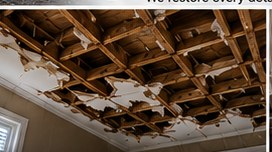
- Down to the floor below. In Long Island homes with a second-floor laundry or a kitchen over a finished basement, the first clue is often a brown stain or sagging spot on the ceiling below. A heavy, wet ceiling can come down, so keep people out from under it.
- Inside cabinets. Particleboard cabinet bases swell and fall apart once they get wet.
Not all appliance water is the same, either. Water from a supply line starts out clean. Water from a washer or dishwasher drain is gray water: it carries detergent, food or dirt and bacteria. Wear gloves, keep kids and pets away, and expect that soaked carpet pad and other porous materials may need to be removed instead of dried.
How appliance leak damage is properly dried
Mopping up the puddle and running a fan is not the same as drying. Professional appliance and fixture leak cleanup follows the water, not just the surface:
- Extract standing water from floors and carpet with emergency water extraction equipment.
- Find all the wet areas with moisture meters and thermal imaging, including under cabinets, inside walls and in the ceiling below.
- Open up what has to be opened. Sometimes that's just removing a baseboard or the toe-kick under a cabinet so air can reach the wet wall. Sometimes it's cutting out soaked drywall or flooring.
- Dry the structure with commercial air movers and dehumidifiers, checking readings every day until the materials are back to normal.
- Repair what had to be removed, from drywall to flooring and cabinets, with water damage repairs and reconstruction.
Wet drywall, wood and carpet pad can start growing mold within 24 to 48 hours. If a leak has been going on for a while, there may already be mold in the wall or subfloor, and that part should be handled as mold remediation, not just drying. We handle appliance leak calls across Nassau and Suffolk, from Baldwin and Bay Shore to Commack.
Insurance: sudden vs. slow leaks
Many homeowners policies cover sudden and accidental water damage, like a washer hose that bursts. Many also exclude damage from repeated leaks over a long time, like a dishwasher that dripped for months. And most policies pay for the resulting water damage, not for the broken appliance itself. Every policy is different, so read yours or call your agent before assuming either way.
What helps any claim: photos and video before cleanup, the failed part (keep the burst hose or cracked line), and written moisture readings. Our insurance claim assistance page explains how we document a job for your adjuster.
Five habits that prevent most appliance leaks
- Replace rubber washer hoses with braided stainless steel, and check them once a year.
- Put inexpensive water leak alarms on the floor next to the washer, dishwasher, fridge and water heater. Some models connect to your phone.
- Consider an automatic shut-off valve on the main line or under the water heater. It closes the water when a sensor gets wet.
- Look under the kitchen sink every month or two for drips, stains or swelling.
- Turn off the washer valves before you travel, or shut the main if you'll be away for a while.
Quick answers
How long before an appliance leak causes mold?
Mold can start in 24 to 48 hours on wet drywall, wood and carpet pad. A slow leak behind a fridge or under a dishwasher may already have mold when you find it.
Is water from a washer or dishwasher dangerous?
Supply line water starts clean. Drain water is gray water and should be treated as contaminated.
Does insurance cover a leaking water heater or washer?
Often for sudden, accidental leaks; often not for slow leaks over time; usually not for the appliance itself. Check your policy.
Can a leaking water heater be repaired?
Leaks from fittings or valves often can. A leak from the tank itself usually means replacement.
Appliance leak? We answer 24/7.
Live dispatch to homes across Nassau & Suffolk County.